Designing a Novel Measure of Human Reasoning on Anthropogenic Climate Change
Objective
Explore how cognitive style, personality, and ideological attitudes shape motivated reasoning when individuals confront information on anthropogenic climate change (ACC) that aligns with or challenges their beliefs.
Background
Despite the monumental strides in modern science, the question arises: Why do unscientific beliefs persist? One reason unscientific beliefs may persist in the face of overwhelming evidence is motivated reasoning. Motivated reasoning is a cognitive bias where beliefs influence information processing. This is particularly evident in beliefs about ACC, leading to a fragmented public opinion despite a clear scientific consensus.
My role and responsibilities
As a graduate student at San José State University, I:
• Collaborated in creating novel study measures and coding scheme.
• Managed the Qualtrics survey and Amazon Mechanical Turk setup.
• Conducted primary data analyses.
• Authored initial drafts and collaborated on report revisions.
• Managed the Qualtrics survey and Amazon Mechanical Turk setup.
• Conducted primary data analyses.
• Authored initial drafts and collaborated on report revisions.
Methods and Approach
Measuring motivated reasoning within climate change:
1. Climate Change Belief Questionnaire: Participants first shared their beliefs on climate change using the Brief Climate Change Belief Questionnaire. This short questionnaire determined participants’ stance on anthropogenic climate change (ACC) using yes/no answers to three items, notably "Do you believe that human activity is primarily causing climate change?"
2. Motivated Reasoning Vignettes: Participants then evaluated a vignette about ACC. This vignette was designed to test participants' ability to identify flawed reasoning irrespective of their personal beliefs about climate change. The vignette showcased two fictional scientists, each representing opposite views on ACC, with both presenting flawed reasoning for their beliefs. Participants wrote responses highlighting the strengths and weaknesses they perceived in each scientist's argument.
3. Response Evaluation: A team of trained raters evaluated these written responses. They categorized the participants' statements based on whether they identified a valid/invalid strength or weakness in the argument. For instance, a valid weakness could be pointing out insufficient evidence, while an invalid strength might be citing unsupported assumptions.
2. Motivated Reasoning Vignettes: Participants then evaluated a vignette about ACC. This vignette was designed to test participants' ability to identify flawed reasoning irrespective of their personal beliefs about climate change. The vignette showcased two fictional scientists, each representing opposite views on ACC, with both presenting flawed reasoning for their beliefs. Participants wrote responses highlighting the strengths and weaknesses they perceived in each scientist's argument.
3. Response Evaluation: A team of trained raters evaluated these written responses. They categorized the participants' statements based on whether they identified a valid/invalid strength or weakness in the argument. For instance, a valid weakness could be pointing out insufficient evidence, while an invalid strength might be citing unsupported assumptions.
| Motivated Reasoning Vignette |
|---|
[Introduce topic] Climate change has inspired a great deal of debate and has prominent individuals on all sides of the issue. [Introduce disagreement] The biggest disagreement arises not so much about whether climate change exists, but rather whether the current period of change is caused by humans or is just in a natural cycle. [Framing issue] Dr. Helmholtz and Dr. Freedlander are both scientists who study climate change. [Introduce individuals] Dr. Helmholtz, a member of the American Meteorological Society, does not believe that humans’ contribution to rising CO2 levels is primarily driving global climate change. [Identify stance & appeal to authority] He conducted a study that found that climate has varied throughout its history and cites this as his primary reason for his belief. [Methodological reasoning error & red herring] Dr. Freedlander, however, a member of the World Meteorological Organization, does believe that humans’ contribution to rising CO2 levels is primarily driving global climate change. [Identify stance & appeal to authority] He primarily believes this due to a study he conducted that found that 2014 was hotter than 1990. [Methodological reasoning error & red herring]
Examples of vignette responses
Examples of Appeal to Authority fallacies:
"Dr. Freedlander is a member of the World Meteorological Organization meaning he is looking to see how climate change affects the entire world not just one country, that is a strength."
Motivated Reasoning Examples:
"The Strength for Dr. Freedlander is the comparative analysis of temperatures between 2014 and 1990. This data lends credence to his theories." & "Dr. Helmholtz weakness in his argument is a lack of empirical data to support his claim. Anyone can say something is true based on history or observation, but unless there is data to back it up you can't believe them."
"Dr. Freedlander to me doesn't have any strengths, his weakness is that he doesn't have much evidence of study or findings for his beliefs." & "Dr. Helmholtz strength of argument, I believe, is that climate temperatures have varied throughout history. I don't really see any weaknesses here."
"Dr. Freedlander to me doesn't have any strengths, his weakness is that he doesn't have much evidence of study or findings for his beliefs." & "Dr. Helmholtz strength of argument, I believe, is that climate temperatures have varied throughout history. I don't really see any weaknesses here."
Examples of equivalent reasoning:
"Dr Freedlander's argument simply looks at a point in time in the past, and notices that it is hotter now. therefore, he concludes, humans are responsible. this fails to take into consideration other factors, or even natural variation in the climate system." & "Dr Helmholtz's argument, that climate has always fluctuated and this is the reason for global warming, is also unsophisticated and limited. He fails to take into consideration factors like C02 that might be driving current climate change."
"Just comparing two arbitrary dates whether it was hotter or not is not enough convince most people in my opinion. It would be better to show a comparison of many dates to show a trend of rising temperatures." & "I think it is obvious that climate has varied throughout history but can his study show that climate has changed as drastically as it right now in another point in history?"
"Just comparing two arbitrary dates whether it was hotter or not is not enough convince most people in my opinion. It would be better to show a comparison of many dates to show a trend of rising temperatures." & "I think it is obvious that climate has varied throughout history but can his study show that climate has changed as drastically as it right now in another point in history?"
Table 1. Motivated reasoning variable derivation
| Variable | Deriving Formula |
|---|---|
| Biased Reasoning | Weaknessesincongruent view + Strengthscongruent view |
| Objective Reasoning | Strengthsincongruent view + Weaknessescongruent view |
| Motivated Reasoning | Biased - Objective Reasoning |
Measures selected to predict motivated reasoning:
A variety of measures were employed to predict participants' motivated reasoning.-
Demographic and Predictor Variables:
Participants provided data on age, gender, education, income, religious affiliation/belief, ethnicity, and country of residence.
-
Cognitive Style:
Three instruments assessed cognitive style:
- Need for Cognition Scale (NFC): A self-report scale gauging cognitive style through items like "I would prefer complex to simple problems."
- Adoption of Scientific Attitudes (ASA) from the Test of Science-Related Attitudes (TOSRA): A scale examining traits like curiosity, willingness to change one’s opinion, and open-mindedness.
- Dogmatism (DOG) Scale: A measure examining "unjustified certainty" with items such as "I am so sure I am right about the important things in life, there is no evidence that could convince me otherwise."
-
Personality:
Two personality dimensions were gauged using the Big Five Inventory (BFI):
- Openness to Experience: Represented by items like "I see myself as someone who is curious about many things."
- Neuroticism: Evaluated by items like "I see myself as someone who is relaxed, handles stress well."
-
Ideology:
- Authoritarian-Conservatism-Traditionalism (ACT) Scale: A scale measuring social conservatism, authoritarianism, and traditionalism with items like "What our country needs most is discipline, with everyone following our leaders in unity."
Our research aimed to identify the relationships between cognitive style, personality, ideology, scientific attitude, and motivated reasoning concerning anthropogenic climate change (ACC). Key findings include:
1. Age and Education: Age impacted beliefs about ACC, with older participants less likely to endorse human-caused climate change than younger ones. College-educated individuals exhibited higher scores on objective reasoning compared to those without a college education. Importantly, those who studied science in college were more prone to agreeing that human activity is causing climate change.
2. Psychological and Ideological Variables: Psychological traits, such as dogmatism and authoritarianism-conservatism-traditionalism (ACT), played significant roles in influencing motivated reasoning. Surprisingly, scientific attitudes did not influence ACC beliefs or reasoning as anticipated.
3. Nature of Reasoning: Participants, regardless of their stance, were primarily employing valid reasoning in their responses. Biased reasoning did not necessarily equate to invalid reasoning. Moreover, our data revealed that even individuals who identify as objective or scientific in their views can be prone to motivated reasoning.
4. The Role of Beliefs: Participants' prior beliefs, especially political or religious, colored their interpretation of evidence concerning ACC. Those leaning conservative, displaying dogmatic tendencies, or identifying as Christian were more likely to reject human activity as a primary cause of climate change.
2. Psychological and Ideological Variables: Psychological traits, such as dogmatism and authoritarianism-conservatism-traditionalism (ACT), played significant roles in influencing motivated reasoning. Surprisingly, scientific attitudes did not influence ACC beliefs or reasoning as anticipated.
3. Nature of Reasoning: Participants, regardless of their stance, were primarily employing valid reasoning in their responses. Biased reasoning did not necessarily equate to invalid reasoning. Moreover, our data revealed that even individuals who identify as objective or scientific in their views can be prone to motivated reasoning.
4. The Role of Beliefs: Participants' prior beliefs, especially political or religious, colored their interpretation of evidence concerning ACC. Those leaning conservative, displaying dogmatic tendencies, or identifying as Christian were more likely to reject human activity as a primary cause of climate change.
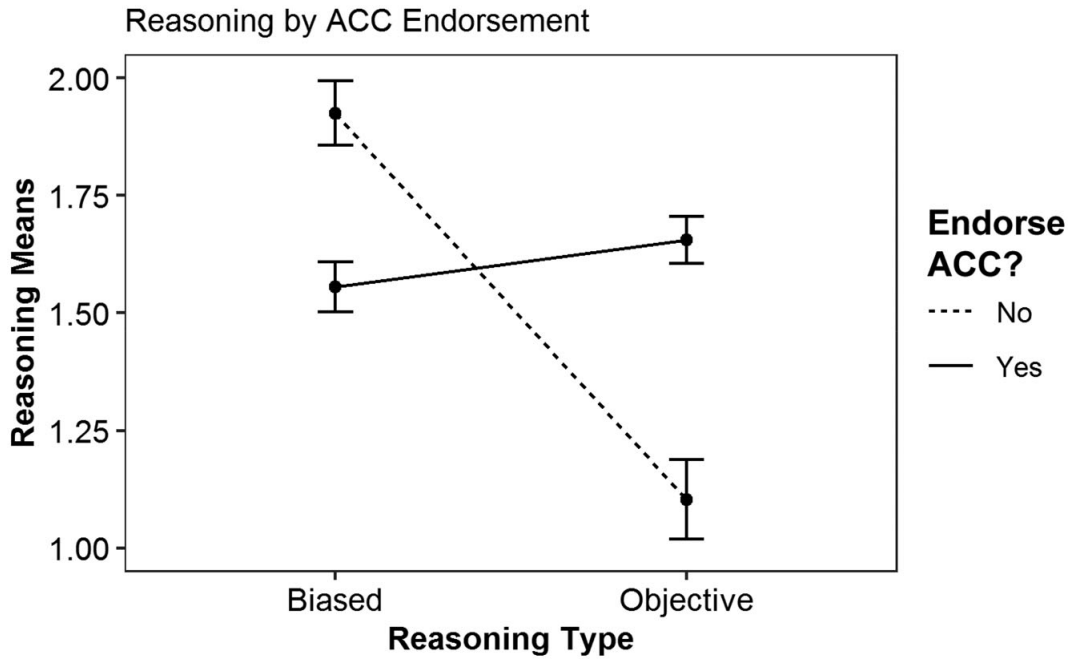
Figure 1. Comparison of reasoning patterns based on ACC beliefs. Equivalent reasoning is seen among those who endorse ACC, in contrast to the noticeably biased reasoning among those who do not endorse ACC.
Significance
Our research provides important contributions to the literature on the psychology of motivated reasoning, with an emphasis on contentious topics such as climate change.
1. Illuminating Cognitive Biases: Our investigation highlights the significant influence of individual beliefs on the interpretation of information. Notably, even individuals who claim a strong adherence to scientific perspectives are susceptible to biases.
2. Unraveling the Basis for Disagreements: Key factors like dogmatism and the interplay of authoritarianism, conservatism, and traditionalism are essential in understanding the discord surrounding issues like ACC. It's crucial to note that aligning with the scientific consensus does not necessarily eliminate the presence of biased reasoning.
3. Relevance to Information Presentation: The inherent challenges posed by motivated reasoning underscore the pressing need to develop strategies for effectively conveying information, especially when it counters prevailing beliefs. This is of paramount importance given the far-reaching consequences associated with decisions on topics like climate change.
4. Navigating Broader Societal Challenges: In today's age of curated information consumption, addressing and counteracting motivated reasoning becomes crucial for facilitating well-informed decision-making processes. As misinformation continues to expand its reach, particularly through platforms like social media, implementing measures to bolster objective reasoning becomes even more critical.
2. Unraveling the Basis for Disagreements: Key factors like dogmatism and the interplay of authoritarianism, conservatism, and traditionalism are essential in understanding the discord surrounding issues like ACC. It's crucial to note that aligning with the scientific consensus does not necessarily eliminate the presence of biased reasoning.
3. Relevance to Information Presentation: The inherent challenges posed by motivated reasoning underscore the pressing need to develop strategies for effectively conveying information, especially when it counters prevailing beliefs. This is of paramount importance given the far-reaching consequences associated with decisions on topics like climate change.
4. Navigating Broader Societal Challenges: In today's age of curated information consumption, addressing and counteracting motivated reasoning becomes crucial for facilitating well-informed decision-making processes. As misinformation continues to expand its reach, particularly through platforms like social media, implementing measures to bolster objective reasoning becomes even more critical.
In summary, while motivated reasoning remains a fundamental aspect of human cognitive processes, our research aims to elucidate its underlying factors, fostering a pathway towards more objective and informed decision-making in areas of significant societal impact, such as climate change.
Collaborators
Gregory Feist (principal investigator)
Associated Publications
Journal Article:
Caddick, Z.A., Feist, G.J., (2021). When Beliefs and Evidence Collide: Psychological and Ideological Predictors of Motivated Reasoning about Climate Change. Thinking & Reasoning, 28(3), pp. 428-464. doi:10.1080/13546783.2021.1994009
Master's Thesis:
Caddick, Z.A. (2016). Evaluating Contradicting and Confirming Evidence: A Study on Beliefs and Motivated Reasoning. Master's Thesis. doi:10.31979/etd.8kt9-vbf7
Caddick, Z.A., Feist, G.J., (2021). When Beliefs and Evidence Collide: Psychological and Ideological Predictors of Motivated Reasoning about Climate Change. Thinking & Reasoning, 28(3), pp. 428-464. doi:10.1080/13546783.2021.1994009
Master's Thesis:
Caddick, Z.A. (2016). Evaluating Contradicting and Confirming Evidence: A Study on Beliefs and Motivated Reasoning. Master's Thesis. doi:10.31979/etd.8kt9-vbf7
Tools and Software Used
Qualtrics, MTurk, R, SPSS, Excel, Mendeley, various scientific search engines (e.g., Google Scholar, PsycInfo).
Resources
1 The journal article can be downloaded here.
2 The master's thesis can be downloaded here.